Nuclear ABC: G is for Generation IV Reactors
What People Get Wrong
Generation IV nuclear reactors often get dismissed before they’re even understood.
The misconception? That they’re just theoretical PR stunts — expensive, risky, and decades away from reality.
Skeptics worry that the advanced technologies involved are untested, prohibitively costly, or too complex to deploy within practical timelines. Others doubt they can truly solve the challenges of nuclear waste, safety, and public perception.
Some argue that investing in advanced reactors draws focus away from renewable energy development.
These misunderstandings overlook the significant real-world progress already being made.
Nuclear Reality Check
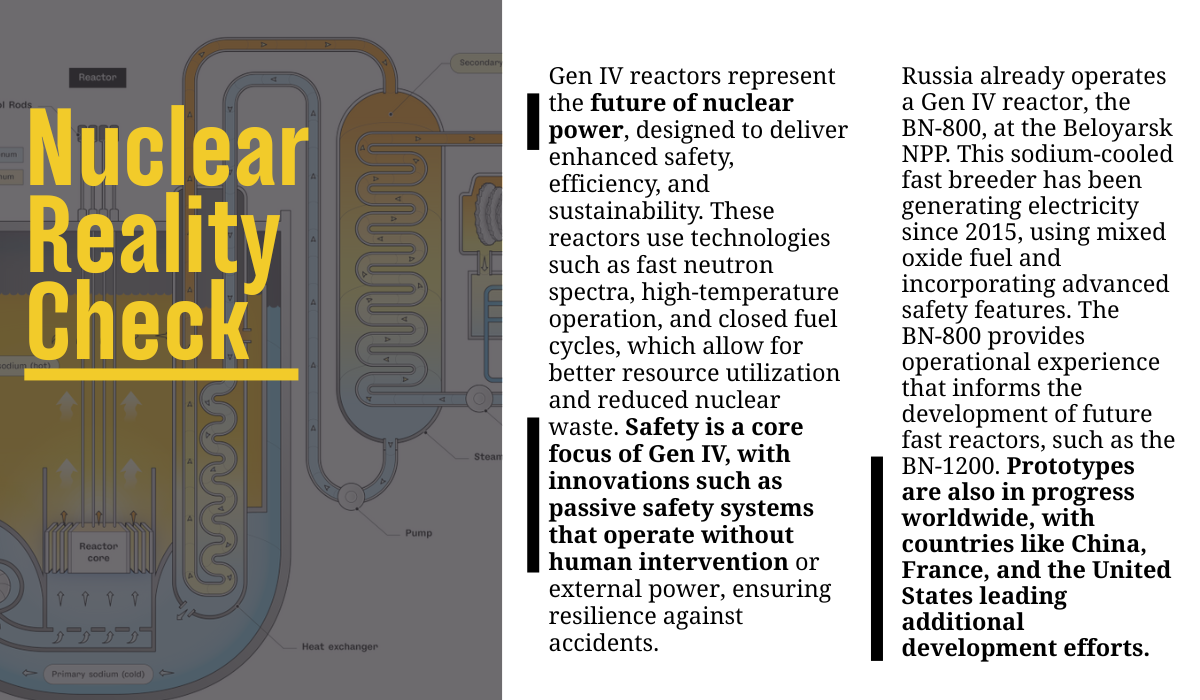
Generation IV (Gen IV) reactors represent the next step in nuclear innovation — designed for greater safety, efficiency, and sustainability.
They incorporate passive safety systems that operate without human intervention, closed fuel cycles to reduce waste, and advanced technologies like fast neutron spectra and high-temperature operation.
This isn’t all theory:
- Russia’s BN-800 sodium-cooled fast breeder has been generating electricity since 2015.
- The BN-800’s operational data supports future designs like the BN-1200.
- Prototypes are under development in China, France, and the United States, with each project contributing to global learning and deployment readiness.
Gen IV isn’t about replacing today’s reactors tomorrow — it’s about building a foundation for safer, cleaner, and more efficient energy for the decades ahead.
Facts That Matter
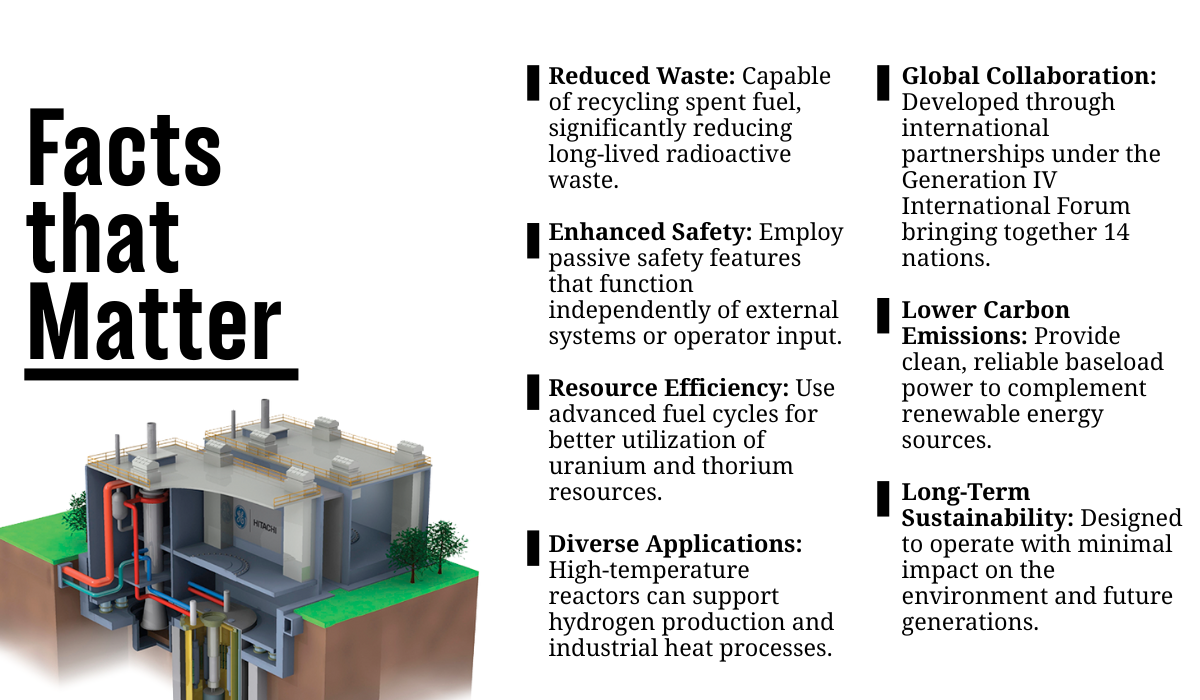
- 🔒 Passive safety: Systems work without external power or operator action.
- ♻️ Closed fuel cycles: Better resource use and reduced long-lived waste.
- ⚡ Fast neutron technology: Extracts more energy from fuel.
- 🌡️ High-temperature operation: Expands industrial applications beyond electricity.
- 🌍 Global prototypes: Real-world testing underway in multiple countries.
- 📊 Operational proof: BN-800 already producing power and data since 2015.